The Fleet
Four classes. One standard.
Every vehicle is chauffeured, maintained to the same bar, and matched to your trip by dispatch — passengers, luggage, and the shape of the day. Hourly figures below are the published card, on a 3-hour minimum.

Representative vehicle; confirm the assigned model, seating and luggage layout with your quote.
01Executive Sedan
The daily driver of executive travel
Quiet cabin, composed ride, and a chauffeur who treats the space as your rolling office. The sedan is the default choice for executive days — productive between stops, invisible at the curb, and exactly right for one or two passengers moving on a schedule.
The sedan is the class most New York work actually calls for, and the reason is fit rather than budget. One or two passengers with standard luggage, a day of meetings or a run to an airport — that is the majority of what moves through this city, and a larger vehicle would add cost without adding anything the trip needs.
It is also the most efficient vehicle in Manhattan, which matters more than it sounds. A narrower car is genuinely easier to bring to a kerb on a crowded Midtown block, and the difference shows up as fewer awkward stops and less circling while you wait in a lobby. On a day with eight stops that compounds.
The cabin works as a rolling office for one or two people. There is room for a laptop, the noise level supports a call, and a passenger sitting alone in the rear has more space than in most private cars. Where the sedan runs out is capacity and weather: four adults with full-size cases, or a hilly outer-borough pickup on an ice morning, are both better served one class up.
Best for
- — Solo travelers and pairs
- — Airport transfers with standard luggage
- — Multi-meeting days across the city
- — Discreet point-to-point movement

Representative vehicle; confirm the assigned model, seating and luggage layout with your quote.
02Premium SUV
Room for the people and the baggage
When the party grows past two — or the luggage grows past a trunk — the premium SUV takes over. Elevated seating, generous cargo room, and the same chauffeured standard as the sedan, scaled for families, small teams, and long-trip luggage.
The SUV earns its place on three distinct kinds of trip rather than one. The first is capacity — three to five passengers, or fewer passengers with more luggage than a boot will take. Families are the obvious case, particularly with child seats, which consume both space and fitting time and are worth flagging at booking so the chauffeur arrives with them installed.
The second is weather and terrain. On a snow or ice morning, and specifically for pickups in the hillier parts of the region — Riverdale, the north shore of Staten Island, the winding roads of northern Westchester — the extra capability is inexpensive insurance when a flight is at stake. Dispatch will suggest it when the forecast warrants rather than waiting to be asked.
The third is simply the longer trip. A run to the East End, up into the Hudson Valley, or down to Philadelphia is a materially better few hours in an SUV, and on a trip of that length the hourly difference is a small share of the total. The practical threshold to remember: luggage volume decides this class more often than passenger count does.
Best for
- — Small groups and families
- — Airport runs with heavy or bulky luggage
- — Child-seat travel arranged in advance
- — Winter weather and longer distances

Representative vehicle; confirm the assigned model, seating and luggage layout with your quote.
03Mercedes-Benz S-Class
The first-class sedan tier
Same seat count as the executive sedan, a different experience entirely. The S-Class is the class you book when the person in the back seat should arrive having genuinely rested — and when the car at the curb is part of what you are communicating. You are paying for the cabin and the ride, not for space.
The S-Class is the one class on this card that is not a capacity decision. It carries what the executive sedan carries — the same passengers, roughly the same luggage — so nobody should book it for space. What it delivers is a step change in cabin isolation and rear-seat comfort, and a presence at the kerb that reads as deliberate.
That combination matters on a specific set of trips: collecting a client or an investor from an international arrival, moving a principal to a meeting where the arrival is part of the message, a milestone evening where the car is part of the occasion, or a long day where a passenger’s comfort is genuinely part of the job.
It is the most expensive class per passenger that we run, and that is the honest frame for the decision. Book it when the impression or the comfort is the point. Do not book it when what the trip actually needed was room — that is the SUV, at less money — and dispatch will say so rather than take the larger booking.
Best for
- — Board-level and principal travel
- — Receiving clients you want impressed
- — Long transfers where ride quality matters
- — Occasions where the car is part of the message
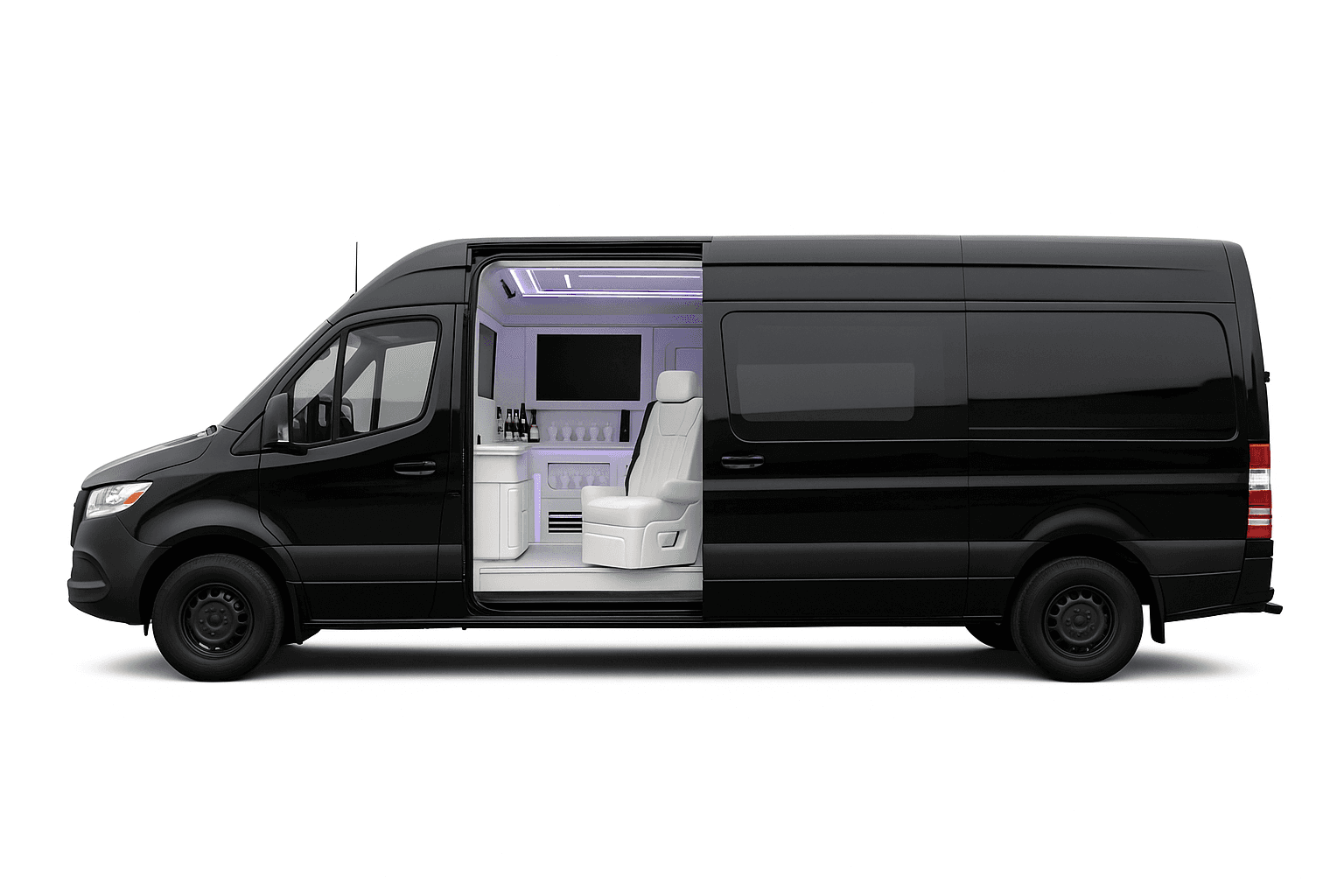
Representative vehicle; confirm the assigned model, seating and luggage layout with your quote.
04Sprinter Van
Group travel without the bus feeling
The Sprinter moves a group the way a sedan moves an executive — together, on time, and without ceremony getting in the way of comfort. Standing-height cabin, real luggage capacity, and a chauffeur managing the logistics while the group manages itself.
The Sprinter solves a problem no other class touches: moving six or more people as a single unit. Its value is cohesion rather than luxury. A group split across two sedans arrives at different times, holds two conversations, and doubles the coordination for the whole day.
The interior is a genuine working and social space. Standing height means people get in and out without contortion, which matters on a day with many stops, and there is real luggage capacity behind the seats rather than a compromise — which makes it the right vehicle for a group heading to or from an airport with checked bags. For a roadshow team it functions as a mobile meeting room; for a wedding party it keeps everyone together and on time.
Two constraints are worth knowing. Sprinters are the scarce class in this market and the group calendar consumes them between May and October, so a summer Saturday is an availability question weeks ahead rather than a price question days ahead. And they are large: some narrow residential streets and some building garages are genuinely difficult, in which case dispatch will propose a nearby staging point rather than discovering the problem on the day.
$240/hour
Configuration confirmed with quote · Confirm passenger and bag counts together
Full rate cardBest for
- — Corporate teams and roadshow crews
- — Wedding parties and event groups
- — Conference and venue shuttling
- — Cruise and group airport transfers
Count the luggage before you count the seats
The most common booking error in this business is counting seats and ignoring bags. A vehicle that seats four does not necessarily carry four people's luggage, and the seat count is the number people remember while the cargo volume is the number that actually constrains the trip. It gets discovered at a kerb, with a flight closing.
The honest thresholds. An executive sedan takes two passengers with a full-size case each, or three travelling light with carry-ons. Add a third large case and it is tight; add a fourth and it does not work regardless of the seating. A premium SUV handles four passengers with full-size luggage without argument, and five with moderate bags. A Sprinter carries a group of six or more with luggage for all of them and still has room left over.
Oversized items break the arithmetic entirely, and they are worth naming at booking: golf clubs, skis, a cello, a folded wheelchair, a pram, a rolling equipment case, boxes of printed materials. Any one of those consumes the space of a large suitcase or more. Dispatch would far rather move you up a class in advance than solve the problem on the pavement.
What is the same across every class
The difference between these four vehicles is capacity and cabin, not standard of service. Every class comes with the same chauffeur standard, advance itinerary coordination, flight tracking on airport work, and a confirmed quote. A sedan booking is briefed, tracked, and coordinated like an S-Class booking.
Pass-through costs behave identically too: tolls, airport fees, parking during holds, and Manhattan's congestion charge on trips entering below 60th Street are itemised at cost rather than absorbed into a rounder number. The three-hour minimum on hourly work applies across all four classes. What you are choosing when you choose a class is the machine, which is why dispatch recommends the cheaper one when the cheaper one fits.
When two vehicles beat one
Occasionally the right answer is not a larger vehicle but two of them. The clearest case is divergent itineraries: if six people arrive together but three are going to a hotel and three straight to a meeting, one Sprinter forces one group to wait and two sedans do not. The same logic applies when part of a group leaves early — a second vehicle is cheaper than holding everyone to the slowest schedule.
The second case is access. If the destination genuinely cannot take a Sprinter, two SUVs may be the practical answer even though the arithmetic favours one van. The case that is usually a mistake is splitting a group across sedans purely to save money: the saving is real on the invoice and then disappears into coordination, separate arrival times, and a group that spent the day reassembling.
How dispatch actually makes the call
When you send an itinerary, the class recommendation comes out of a short sequence rather than a preference. Luggage volume first, because it is the hard constraint and the one most often understated. Then passenger count, including anyone joining mid-day. Then the shape of the day: a single transfer tolerates a tighter fit than eleven hours of getting in and out, where four adults in a sedan stop being viable somewhere around the fourth stop.
After that, three modifiers. Whether the arrival is being received by someone — a client, an investor, a senior visitor — which is the only real argument for the S-Class. Whether the weather or the terrain argues for the SUV, which it does on ice mornings and in the hillier parts of the region. And whether anything unusual is travelling: child seats, sports equipment, instruments, mobility aids, or materials for a meeting.
The output is a recommendation with the reasoning attached, and it frequently points downward. Talking a booking out of an S-Class into an executive sedan when nobody is being received is a common conversation here, because the difference buys nothing the day needs. The opposite conversation — up from a sedan to an SUV because four people with a week of luggage were never going to fit — is more common still.
Maintenance, and what we will not claim
Vehicles are kept to a standard that assumes a passenger will spend real hours in them: serviced on schedule, cleaned between assignments, and taken out of rotation when something is not right rather than sent out and apologised for. A chauffeur who reports a fault takes the vehicle off the day; dispatch reassigns rather than arguing.
What this page deliberately does not do is publish a specification sheet of model years, trim levels, or amenity lists we cannot guarantee on every assignment. Those lists are the easiest thing in this industry to write and the hardest to honour, and an operator who promises a specific model and delivers a substitute has taught you something about the rest of its promises. If a particular requirement genuinely matters for your trip, raise it at booking and you will get a straight answer about whether we can meet it.
Seasonal reality
Two patterns are worth planning around. Winter shifts recommendations toward the SUV, particularly for early departures from the hillier parts of the region, where thirty dollars an hour is inexpensive against a missed flight. And between May and October the group calendar consumes Sprinters — weddings, graduations, conferences — which makes a summer Saturday an availability question weeks ahead rather than a price question days ahead.
If you want the reasoning at length, the vehicle comparison guide works through each threshold with worked examples, and the rate card carries the full commercial structure including what is and is not included.
Fleet questions
How do I know which class my trip needs?
Give dispatch the passenger count, an honest luggage count, and the shape of the day. Luggage decides it more often than passengers do — sedans are listed for up to three passengers; larger parties or bulky luggage need a different class. The recommendation comes with every quote, and it points at the cheaper class when the cheaper class fits.
Can you fit child seats?
Yes, with notice. Tell us how many and roughly what ages at booking and the chauffeur arrives with them correctly fitted rather than installing them at the kerb. Two child seats effectively rule out a sedan, so this can change the class — another reason to raise it in advance.
Is the S-Class bigger than the executive sedan?
No. Same passenger count, roughly the same luggage. What it adds is cabin isolation, rear-seat comfort, and presence at the kerb. If the trip needs space rather than an impression, the premium SUV is the right answer and it costs less per hour.
What if my street cannot take a Sprinter?
Dispatch will tell you before the day rather than after, and will usually propose a staging point a short walk away. Narrow residential streets in parts of Brooklyn and Queens, and some building garages, are genuinely difficult for a vehicle that size.
Can I request a specific make or model?
You can ask, and we will tell you honestly whether we can commit to it for your date rather than promising and substituting. The S-Class is the one class defined by the vehicle itself; the other three are specified by capacity and standard, which is what lets dispatch guarantee the booking.
How far ahead should I book a Sprinter?
Weeks, for anything between May and October or on a holiday date. Sprinters are the scarce class in this market and the group calendar consumes them first, so on those dates the binding constraint is availability rather than price — a party that waits until the week of an event may find the vehicle already committed.
Does the vehicle stay with me between stops?
On an hourly booking, yes — that is what the block reserves. The chauffeur holds nearby or circulates on a known pattern rather than being dispatched on request, so bags, coats, and materials stay aboard and the car is minutes away when you step out.
Does the service standard change with the vehicle?
No. Every class gets the same chauffeur standard, the same advance itinerary coordination, the same flight tracking on airport work, and the same confirmed quote. What you choose when you choose a class is the vehicle, not the way the trip is planned.
Not sure which vehicle?
Tell dispatch your passenger count, luggage, and the shape of the day. The right class is part of every quote — no guesswork on your end.
Reservations
Your itinerary, handled.
Share the trip — addresses, flights, passengers — and receive a clear quote before anything is booked. Dispatch takes it from there.